
UNY Student Team Develops Neurease to Support Children with Autism at Special Needs Schools
Submitted by adm1n on Wed, 2026-09-09 06:55
Yogyakarta. A student team from Universitas Negeri Yogyakarta (UNY) is making steady progress on Neurease, a project under the Student Creativity Program for Innovative Creations (PKM-KC). Neurease combines wearable sensors with artificial intelligence to detect early signs of pre-tantrum behavior in children with Autism Spectrum Disorder (ASD). Heading into July 2026, the team is working through key development stages: assembling the hardware, training the AI model, and designing the app's user interface.
For the hardware, the team is soldering electronic components that form the core of the wearable device. This step makes sure all sensors and modules connect properly and perform as designed.
At the same time, work on the AI system is moving forward through model training. This trains the system to recognize patterns linked to pre-tantrum states, giving Neurease more accurate predictive capabilities once fully deployed.
Alongside the hardware and AI work, the team is refining the app's front-end interface. They are focusing on a clean, responsive layout that is easy for teachers, shadow teachers, and parents to navigate. With a straightforward interface, users can quickly review real-time emotional monitoring data without friction.
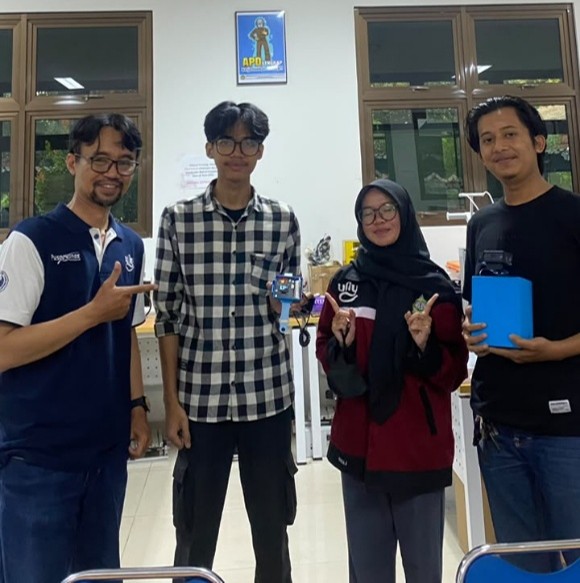
The team leader explained that splitting the project into distinct phases helps them refine each piece before bringing everything together.
"Right now, we are building all three main components in parallel: the hardware, the AI model, and the app. Our goal is to integrate them smoothly so Neurease functions just as intended," the team leader said.

Through this ongoing work, the UNY team hopes Neurease can deliver real, practical value for early emotional tracking in children with ASD, rather than just serving as a tech experiment. Once all components are built, the team will move on to system integration and testing. After that, they plan to test the device directly at SLB Autis Bina Anggita to evaluate how well it works in a real classroom setting.